This blog post was submitted by Sarah Osberg, Mountain Adventure Skills Training program coordinator and instructor.
We are halfway into the academic year in the Mountain Adventure Skills Training (MAST) program at College of the Rockies, Fernie Campus. Reflection is such a key aspect of learning and application, and as program coordinator and instructor I wanted to take a moment, at the start of this new year, to pause, reflect, and acknowledge the progress we’ve made so far.
As we wander, learn, climb and engage deeply with our group, activities and environment, we may wonder what this experience is really about. As we practice new mountain skills, they become second nature, and our independence and confidence grow. There are moments of flow where time seems to disappear, and our bodies and minds work together to focus on the challenges we face. Our group moves from strangers to a close-knit community, bonded by laughter, common understanding, and teamwork
Mountain adventure is all of this while also being grounded in real career pathways in the adventure recreation and tourism sectors. The program nurtures diverse skillsets, from technical abilities such as route-finding and track setting through bush or snow, to navigation using map and compass and modern digital tools. MAST also helps cultivate interpersonal skills including teamwork, leadership, planning and group work.
Like many learning leaps, participation in MAST often marked by ups and downs, much like shifting weather systems. A crest might be a moment of elation while experiencing new challenges or developing a sense of achievement. However, adventure also involves uncertainty and adversity, similar to a weather trough, and in our natural world control is, at least in part, relinquished to our natural systems.
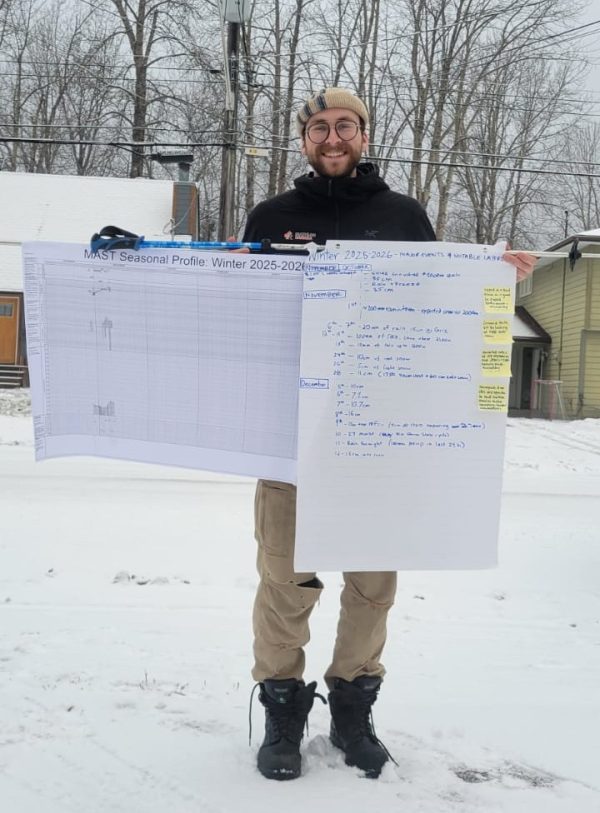
Each year the MAST students track the snowpack from the start of the season until the spring. We study how snow behaves and changes and how conditions create favorable or unfavorable conditions for avalanches, thus managing our risk over terrain. Our weather events are charted and our snowpack measured. In December, we completed most of our Avalanche Skills Training level one course. With numerous low-pressure systems moving across the southern province and freezing levels remaining high but fluctuating, we were able to discuss significant impacts to the snowpack. Natural storm slab avalanche cycles continued up high while our lower snowpack melted out at mid- to -low elevations.
The Avalanche Canada Instructors were impressed with the MAST students’ personal leadership and inter- and intra-personal skills. We grounded our understanding of weather and snowpack conditions in science and with the expertise of avalanche forecasters. This in turn, guided our decision making and risk management. While simple decision making was not on the docket, we know that -metaphorically as well as in real life – we will encounter diverse learning conditions shaped by low- and high-pressure systems. Navigating uncertainty and adversity with confidence, momentum and solution-focused thinking is part of mountain adventure and was demonstrated through flexible growth mindsets.